


ZMT Newsletter #02/2025
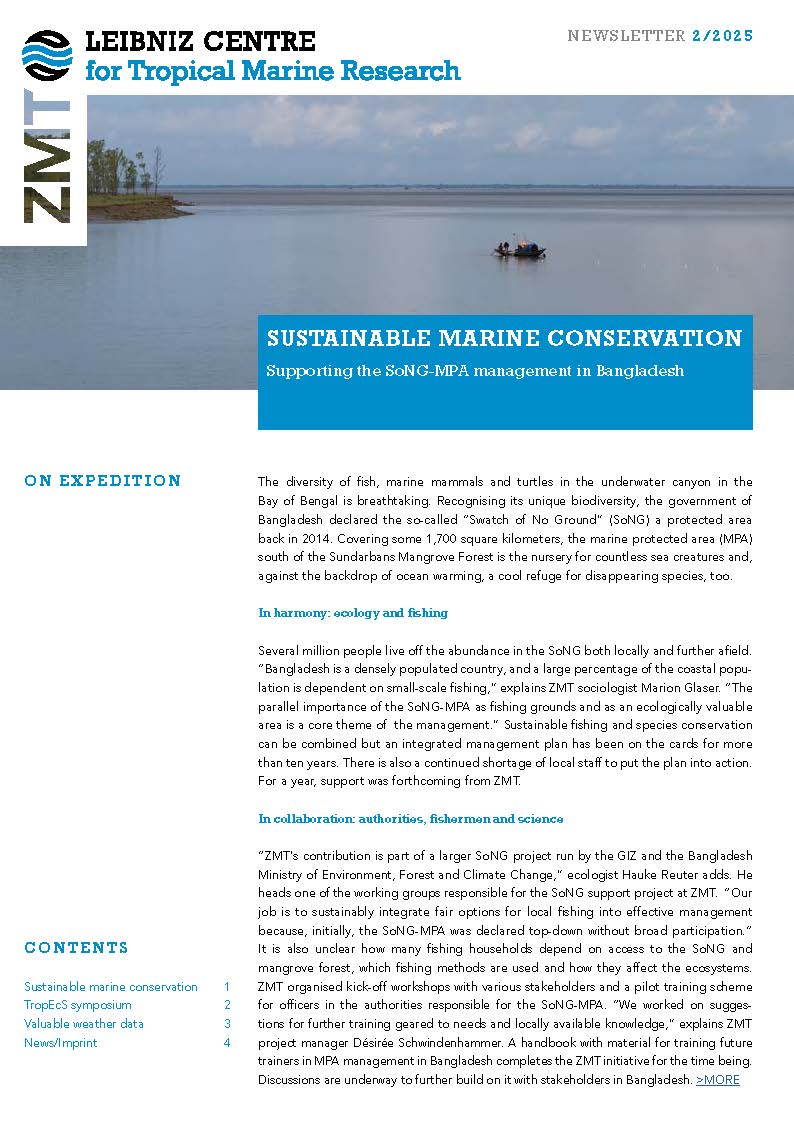
This edition of our newsletter takes you to a unique marine protected area south of the Sundarbans Mangrove Forest in Bangladesh – the “Swatch of No ground”. Here, ZMT has been contributing to the sustainable integration of fair and viable options for local fishers into the management of the MPA.
Closer to home, the spotlight was on a three-day symposium that marked the official launch of our new institute extension TropEcS. More than 100 international experts, early-career researchers, colleagues, and partners from tropical regions – stretching from Indonesia to Peru – gathered in Bremen to discuss and explore how tropical coastal ecosystems can be better integrated into global Earth System Models. With this symposium, ZMT took an important first step towards strengthening its modelling capacities and highlighting the crucial role of coastal and marine processes in understanding global change.
Earth system modelling – and climate research in particular – depends on accessible, high-quality data. In this issue, two of our climate scientists share insights into their work collecting and exchanging weather data.
Finally, our news section offers an overview of ZMT’s latest activities – from partnerships and capacity development to research updates and participation in high-level conferences such as UNOC3.
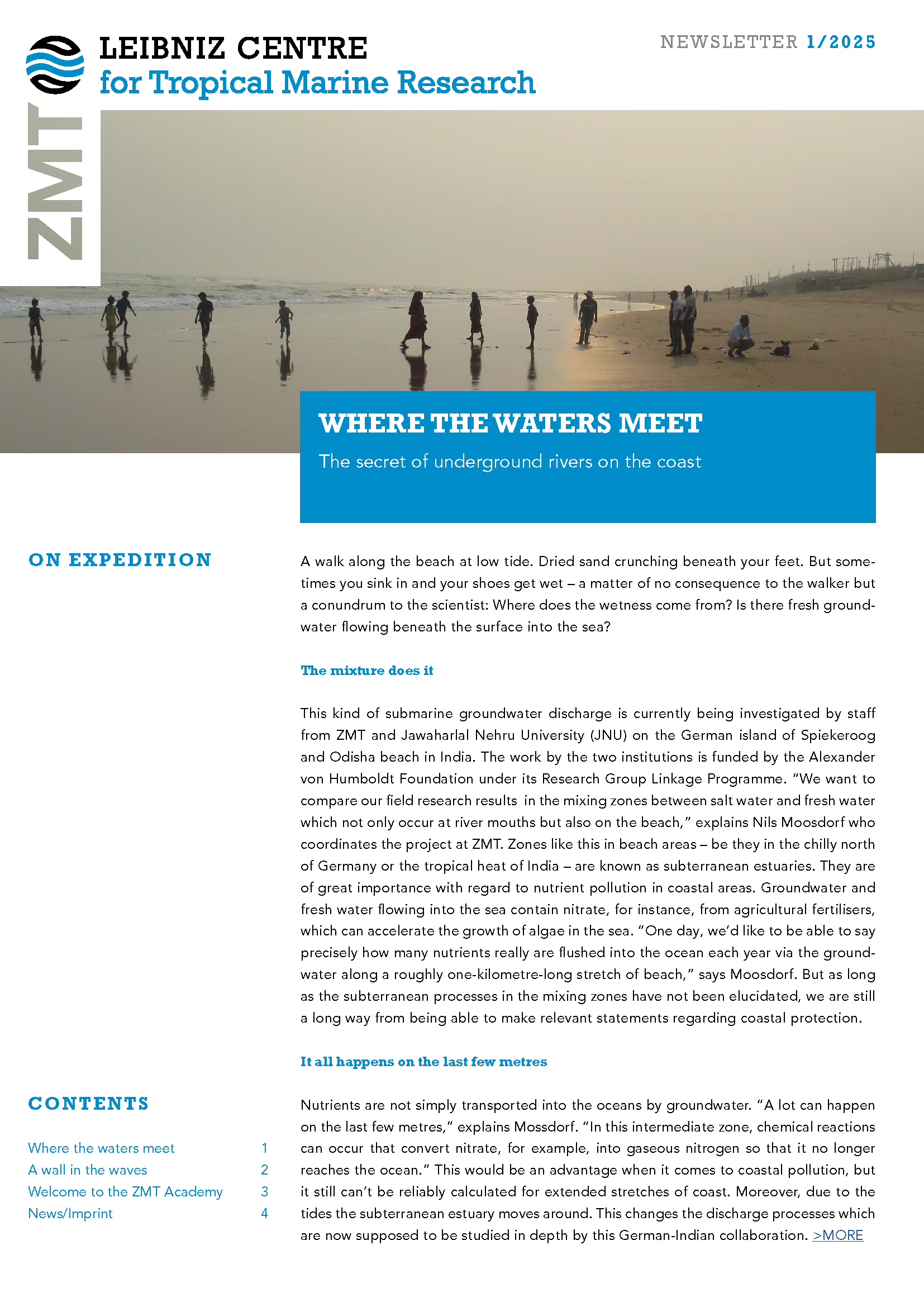
Where the waters meet
The secret of underground rivers on the coast
A walk along the beach at low tide. Dried sand crunching beneath your feet. But some-
times you sink in and your shoes get wet – a matter of no consequence to the walker but
a conundrum to the scientist: Where does the wetness come from? Is there fresh ground-
water flowing beneath the surface into the sea?
ZMT Newsletter #01/2025
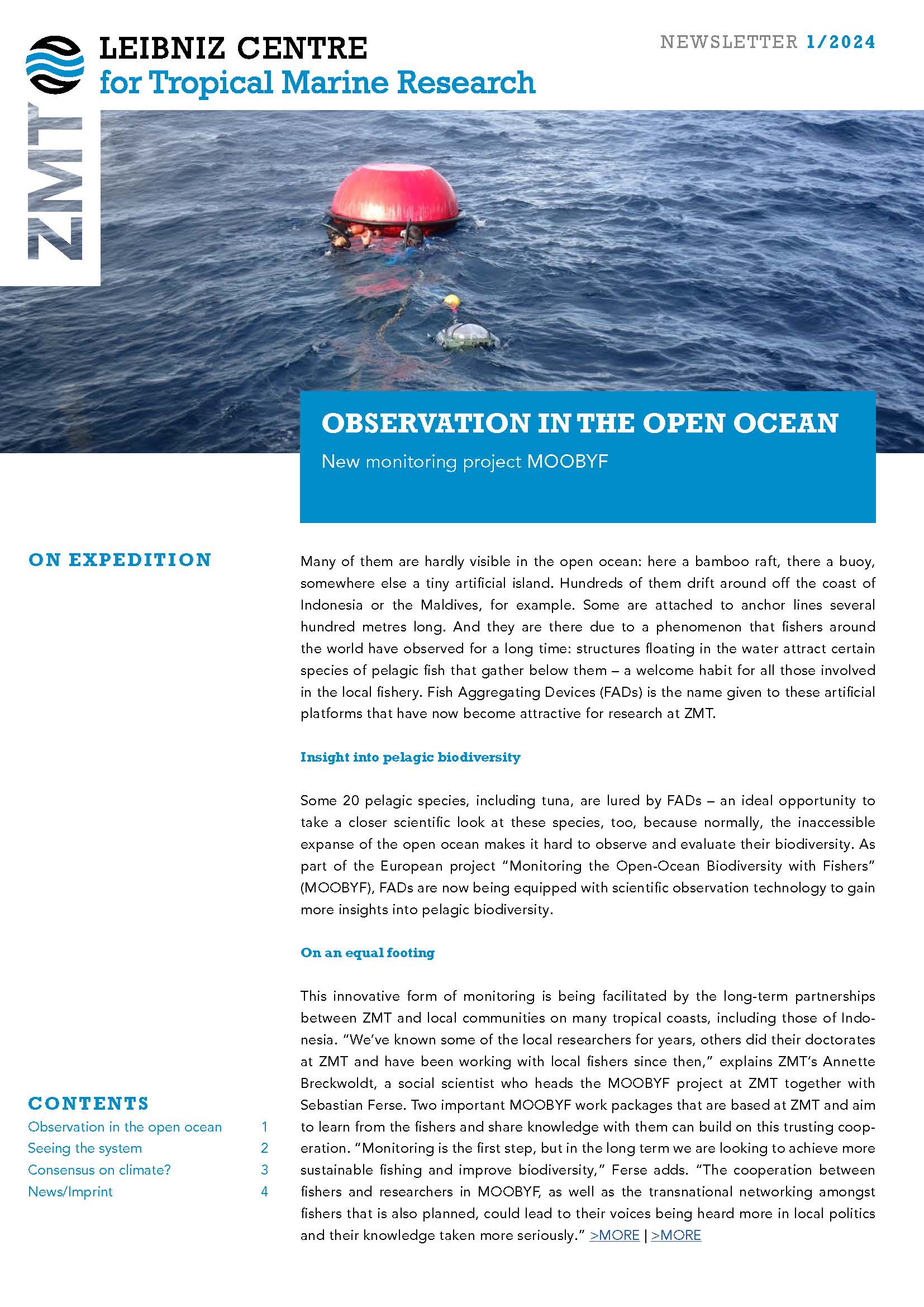
Observation in the open ocean
New monitoring project MOOBYF
Many of them are hardly visible in the open ocean: here a bamboo raft, there a buoy,
somewhere else a tiny artificial island. Hundreds of them drift around off the coast of
Indonesia or the Maldives, for example. Some are attached to anchor lines several
hundred metres long.
ZMT Newsletter #01/2024
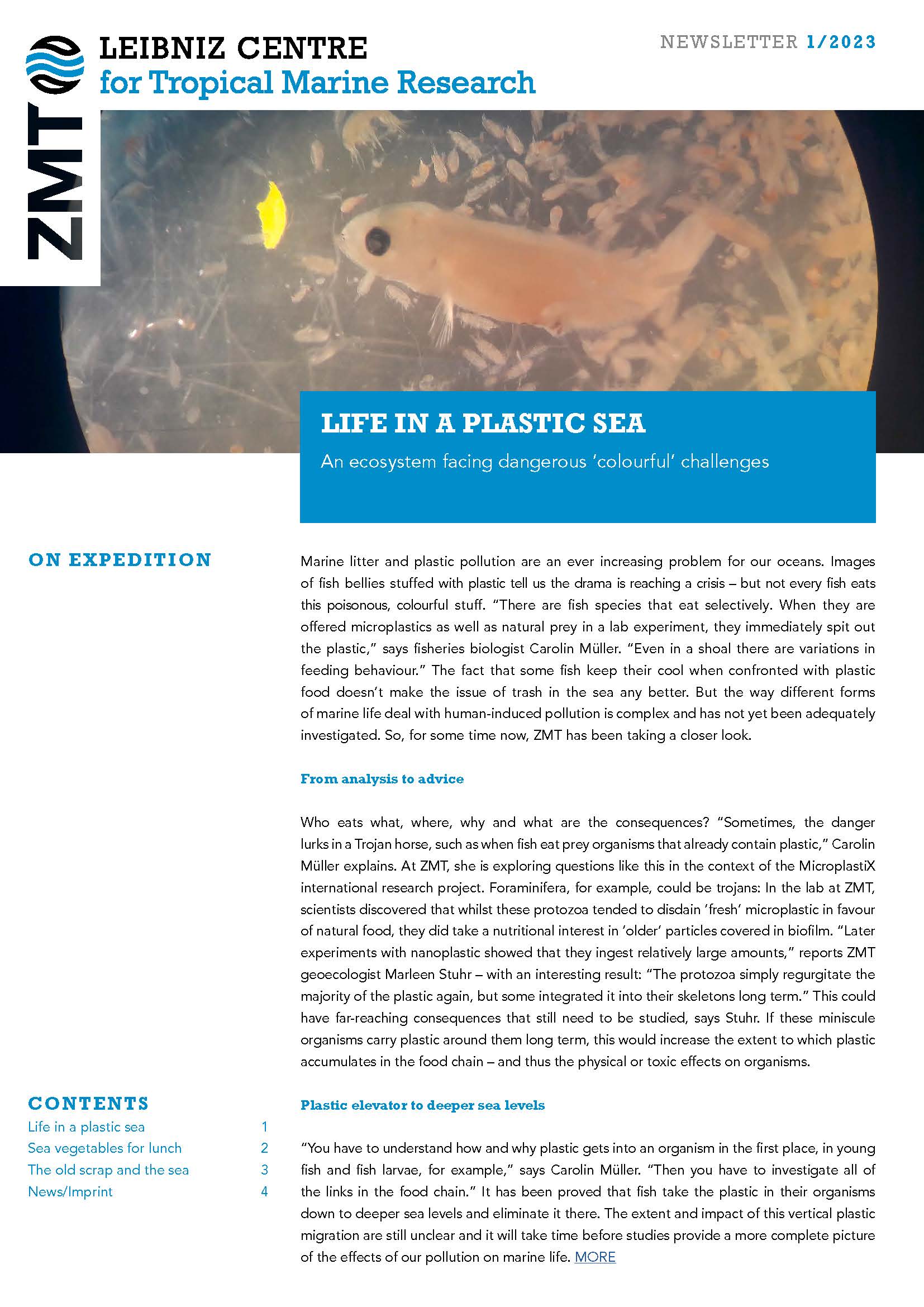
Life in a Plastic Sea
An ecosystem facing dangerous ‘colourful’ challenges
Marine litter and plastic pollution are an ever increasing problem for our oceans. Images
of fish bellies stuffed with plastic tell us the drama is reaching a crisis – but not every fish eats
this poisonous, colourful stuff
ZMT Newsletter #01/2023
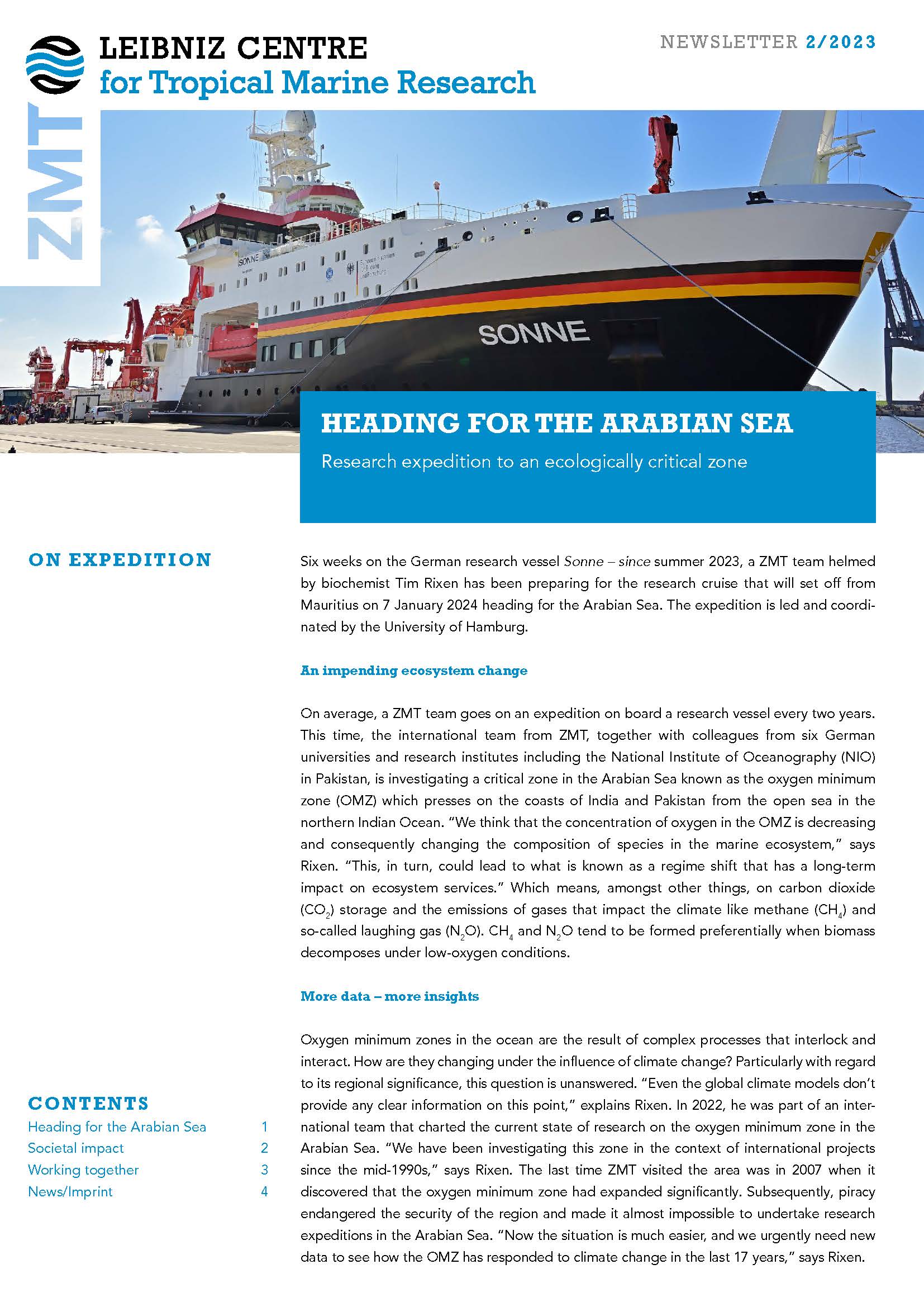
Heading for the Arabian Sea
Research expedition to an ecologically zone
Six weeks on the German research vessel Sonne – since summer 2023, a ZMT team helmed
by biochemist Tim Rixen has been preparing for the research cruise that will set off from
Mauritius on 7 January 2024 heading for the Arabian Sea. The expedition is led and coordi-
nated by the University of Hamburg.
ZMT Newsletter #02/2023
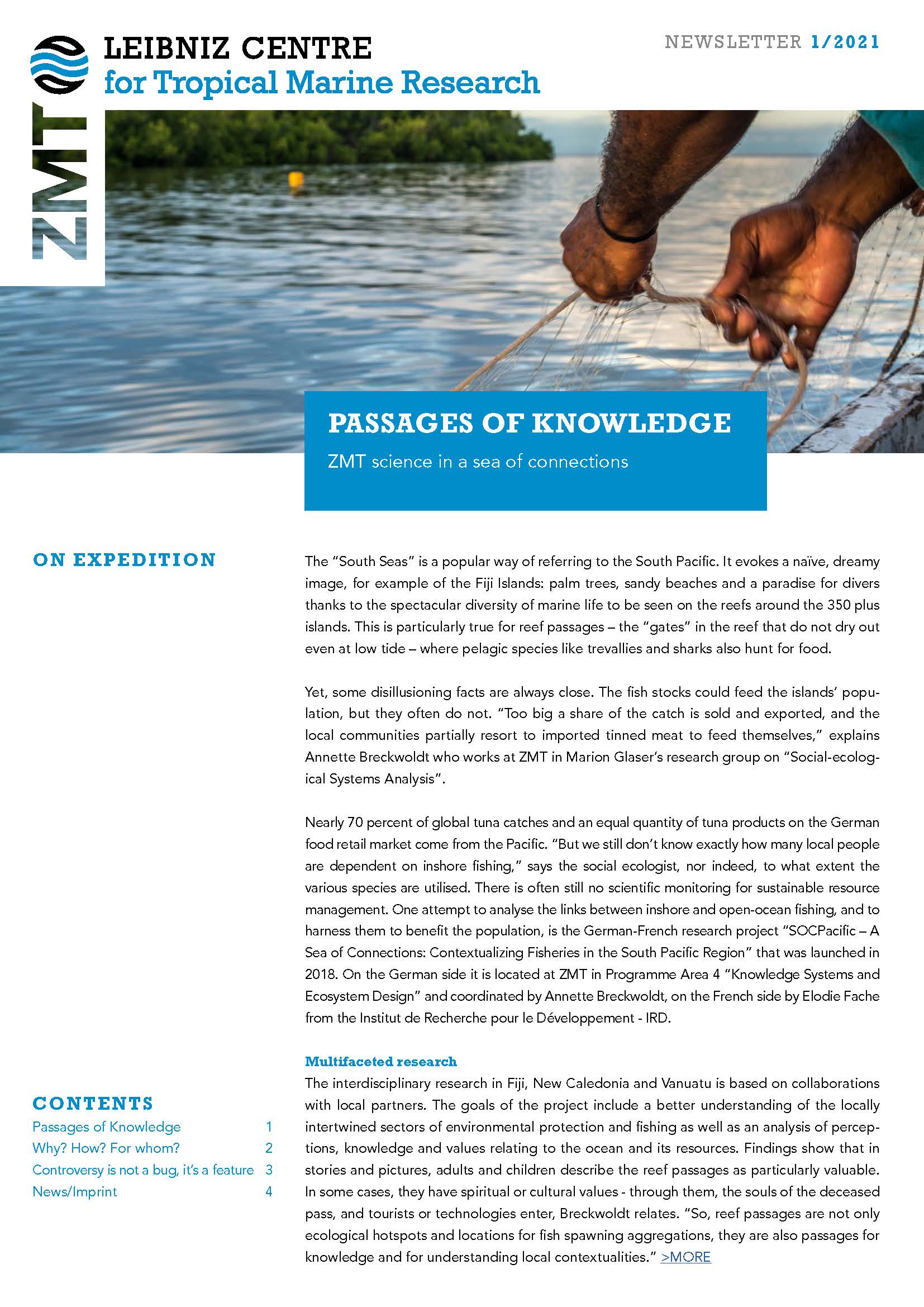
Passages of Knowledge
The “South Seas” is a popular way of referring to the South Pacific. It evokes a naïve, dreamy
image, for example of the Fiji Islands: palm trees, sandy beaches and a paradise for divers
thanks to the spectacular diversity of marine life to be seen on the reefs around the 350 plus
islands. This is particularly true for reef passages – the “gates” in the reef that do not dry out
even at low tide – where pelagic species like trevallies and sharks also hunt for food
ZMT Newsletter #01/2021
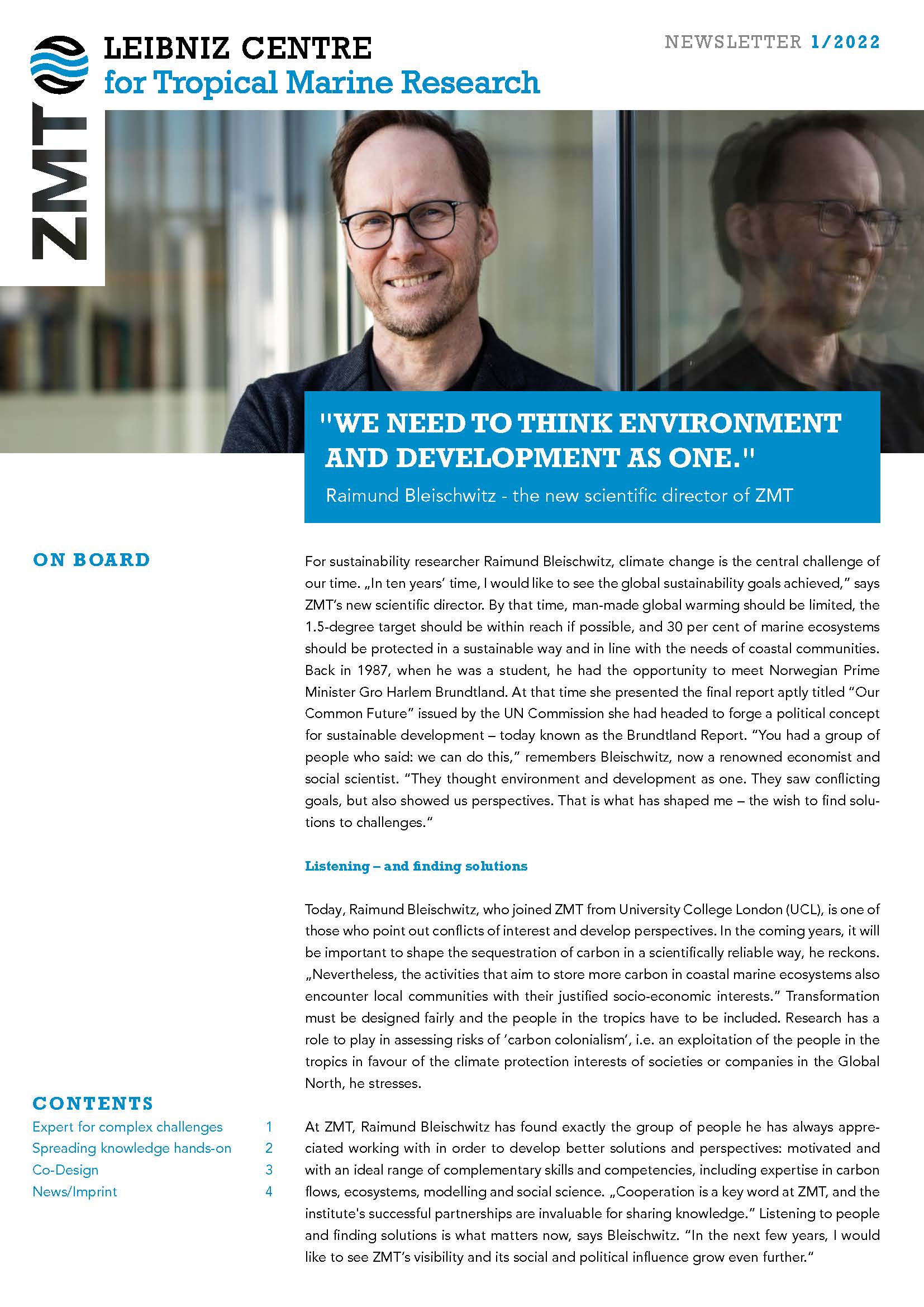
"We need to think environment and development as one."
Raimund Bleischwitz - the new scientific director of ZMT
For sustainability researcher Raimund Bleischwitz, climate change is the central challenge of
our time. „In ten years’ time, I would like to see the global sustainability goals achieved,” says
ZMT’s new scientific director. By that time, man-made global warming should be limited, the
1.5-degree target should be within reach if possible, and 30 per cent of marine ecosystems
should be protected in a sustainable way and in line with the needs of coastal communities.
ZMT Newsletter #01/2022
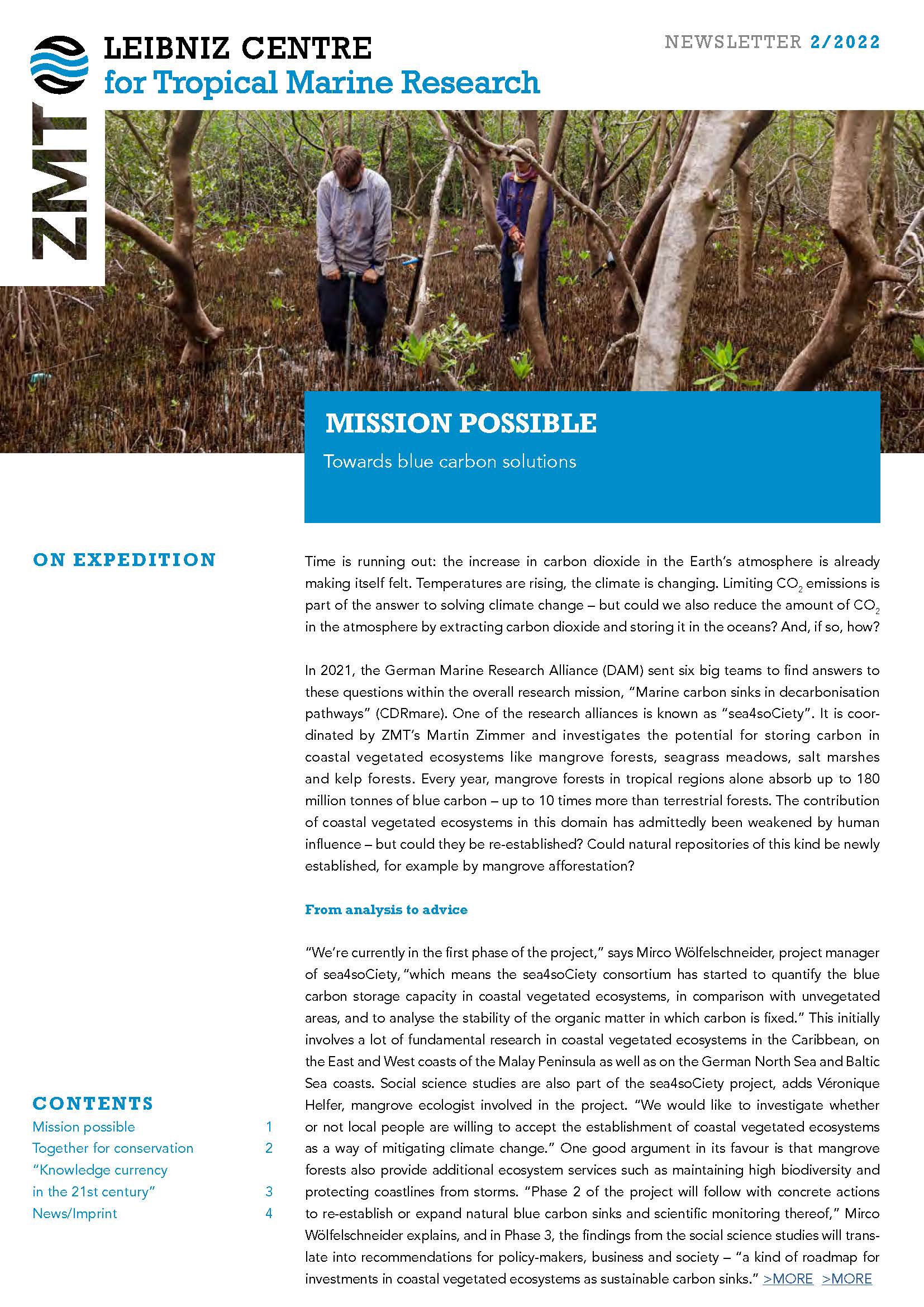
Mission Possible
Towards blue carbon solutions
Time is running out: the increase in carbon dioxide in the Earth’s atmosphere is already
making itself felt. Temperatures are rising, the climate is changing. Limiting CO2 emissions is
part of the answer to solving climate change – but could we also reduce the amount of CO2
in the atmosphere by extracting carbon dioxide and storing it in the oceans? And, if so, how?
ZMT Newsletter #02/2022
FOOD FOR THE FUTURE
Towards sustainable nutrition worldwide
The figures for fish caught around the world are falling – as the statistics published by the
United Nations’ Food and Agriculture Organisation (FAO) over recent years have revealed.
But in the future, food from the ocean will be more important than ever if we are to meet
the protein requirements of a growing world population.
ZMT Newsletter #01/2020
The Challenge of Big Change
ZMT Programme Area 2 - “Global Change Impacts and Social-ecological Responses”
It is impossible to record the effects of climate change on the oceans and tropical coasts on
a solely regional basis. With the changes in water temperature, for example, fish stocks move
across national borders or mussels settle where no mussels lived before.
ZMT Newsletter #02/2020